
By reviving and restoring the prestige of this historic brand, Stade, Maison Ferrand aims to create limited edition rums that showcase the Barbadian terroir and its history. The recipes will be drawn from the famous vault that has protected the distillery’s secrets for 130 years (brought up to date by Alexandre Gabriel), and the raw materials will be local, including pure cane juice! Two vintages, Vulcan, Two Taps, and Old Gregg, Fusion, are already available. Others will follow soon!
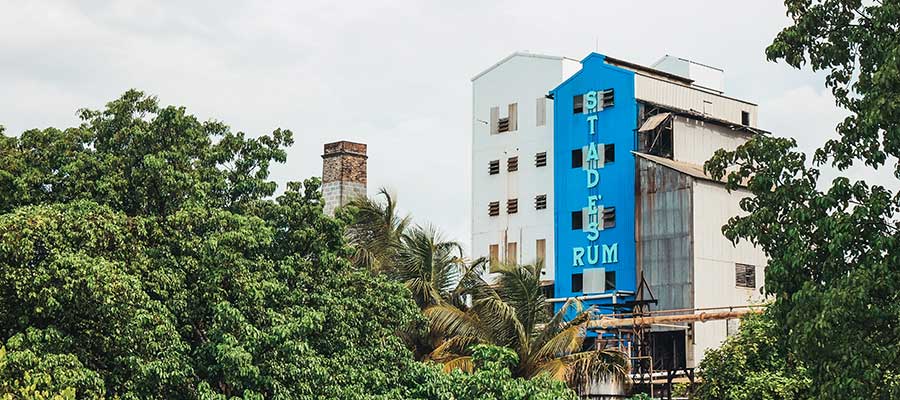
Although Stade’s was officially launched internationally at Whiskey Live 2025, it is not as recent as one might think. Firstly, because it comes from the legendary WIRD (now Stade’s West Indies Rum Distillery), secondly because it has always been used locally in Barbados, and finally because it bears the name of a historical figure who lived between the late 19th and early 20th centuries: George Stade. So it is with him that we will begin our journey into the world of the brand.
Stade, the genius of Barbados rum
Located on Brighton Beach, about ten metres from the Caribbean Sea and just 1.6 kilometres from the capital Bridgetown, the distillery, previously known as WIRD, was founded by George Stade and his brother in 1893 with the aim of creating the best rum.
Their idea? To use their scientific knowledge to create the best possible spirit in the very place where rum was born. Stade was an engineer specialising in sugar processing and distillation equipment, and he developed 44 patents, notably for stills and columns.
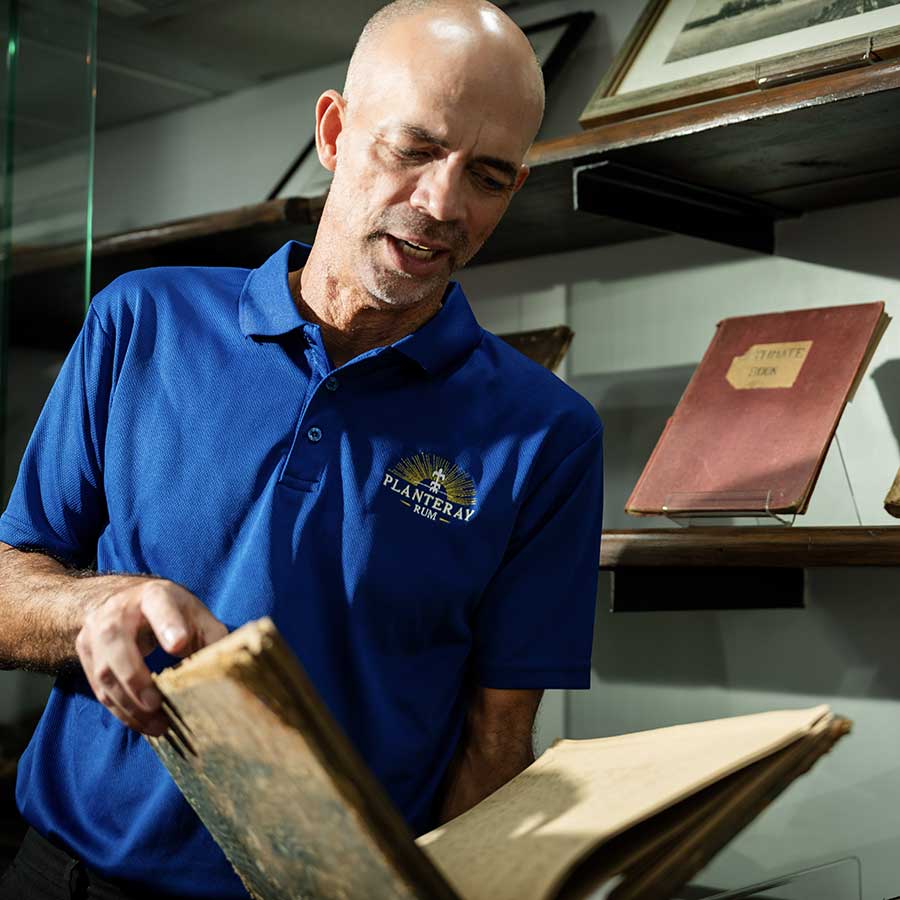
In his distillery, he even installed a 15-square-metre room, a kind of vault that closes like a bank safe. Hence its name, the Distillers Vault. Was it used to store gold bars? No, but rather to keep his patents, recipes and other blueprints. This room is still there today, and the distillery has been documenting all its activities there for 130 years.
For several years now, Alexandre Gabriel and his teams have been using these secrets to restore some of the old stills they found when they arrived, or to test new vintages and techniques inspired by the past.
From local to international
But let’s get back to George Stade. Success came quickly, as his rum was the most aromatic and ‘cleanest’ on the island (meaning it contained no harmful compounds). It was considered so delicious that the British government’s chief chemist himself asked to come and work with him.
But Stade quickly came up against the vested interests of the bourgeoisie and local merchants. ‘The latter manoeuvred to get Parliament to prevent him from selling directly on the market,’ says Alexandre Gabriel, who acquired the distillery in 2017 through Maison Ferrand.
He was therefore forced to sell his rum in bulk to numerous bottlers and was never able to make his full margin.” As he had invested heavily in building and launching the distillery, he quickly ran out of money. He then sold his shares in the distillery. Stade eventually left Barbados and went on to live an eventful second life. ‘It is even said that he was arrested in Germany as a spy for the British Crown at the end of the First World War,’ reveals Alexandre Gabriel.
However, the name Stade persists, and even continues to appear on most bottles of Barbadian rum. So much so that it has become synonymous with rum for Barbadians, who order a glass of Stade’s rather than a glass of rum. However, its fame remains largely confined to the island. That is, until September 2025 and its resurrection under the auspices of Alexandre Gabriel and his teams. But why launch a new brand when you already have several rum brands (Planteray, Canerock, etc.)? To do something new, of course! Whereas Planteray’s DNA is blending and double ageing (tropical and continental), Stade’s credo will be the Barbadian terroir. Its promise? A rum that is 100% sourced from Barbados, with local raw materials, fermentation, distillation and ageing carried out entirely on site! A real revolution that has actually been in the making for several years.
The West Indies Central Sugar Cane Breeding Station
One of the lesser-known aspects of Stade’s West Indies Distillery is its work with Barbadian sugar cane varieties. However, to discuss the present, we must first take a look back at the past.
In 1883, a certain Mr Harper explained, without anyone listening, that by selecting and planting the same varieties of sugar cane everywhere, the grass would become impoverished and eventually die out, as it would fall prey to pests and diseases.
This was similar to what was happening in European vineyards with phylloxera. His prediction soon came true in the 1870s, when sugarcane died and was decimated almost everywhere. In 1880, a rather brilliant man named John Redman Bovell took up Harper’s work and created the Sugar Cane Breeding Station, a research centre dedicated to sugarcane.
He wanted to develop varieties of sugar cane that were resistant to disease and pests. His memory lives on, as he appears on Barbadian two-dollar notes, which are said to bring good luck when carried in your pocket. This enabled Barbados to become one of the main centres for sugar cane research and to develop many of the varieties currently used to produce rum.
So, whenever you see a variety whose scientific name begins with B, it comes from Barbados (R for Réunion). The two digits immediately after that are the year of creation. And after that is the creation sequence. One example among dozens of others: the famous ‘blue cane’ is actually called B69 566 and originates from the Cane Breeding Station in Barbados. ‘A place where, even today, research is carried out on 3,000 varieties of cane and with which the WIRD distillery has been a partner for six years,’ reveals Alexandre Gabriel.
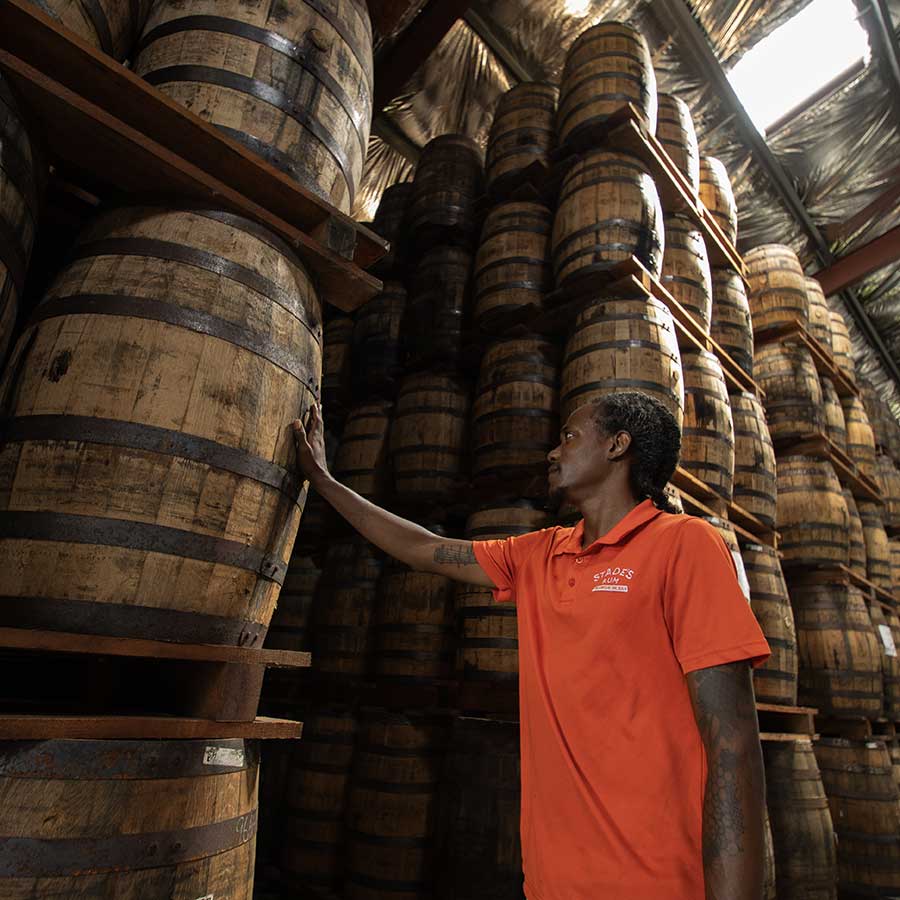
Sugarcane intended for rum production
The WIRD farm, Kendall Farm (first documented in 1657), is located in the middle of the island. Hybridisation work is carried out on 30 acres (approximately 12 hectares) of cane varieties located in the Redlands, an area that was still part of the Caribbean Sea several millennia ago.
Thirty acres of coconut trees used for Cut & Dry are also cultivated there. ‘Ram, who worked at Caroni for 20 years and joined the team eight years ago, is in charge,’ explains Alexandre Gabriel. He always says, “I am the cane man”.”
For the moment, research and experimentation have focused on five varieties: Early Bird, so called because it arrives earlier than the others. Yellow Lady, which is also used by Renegade in Grenada. Purple Cane, which takes its name from its characteristic colour.
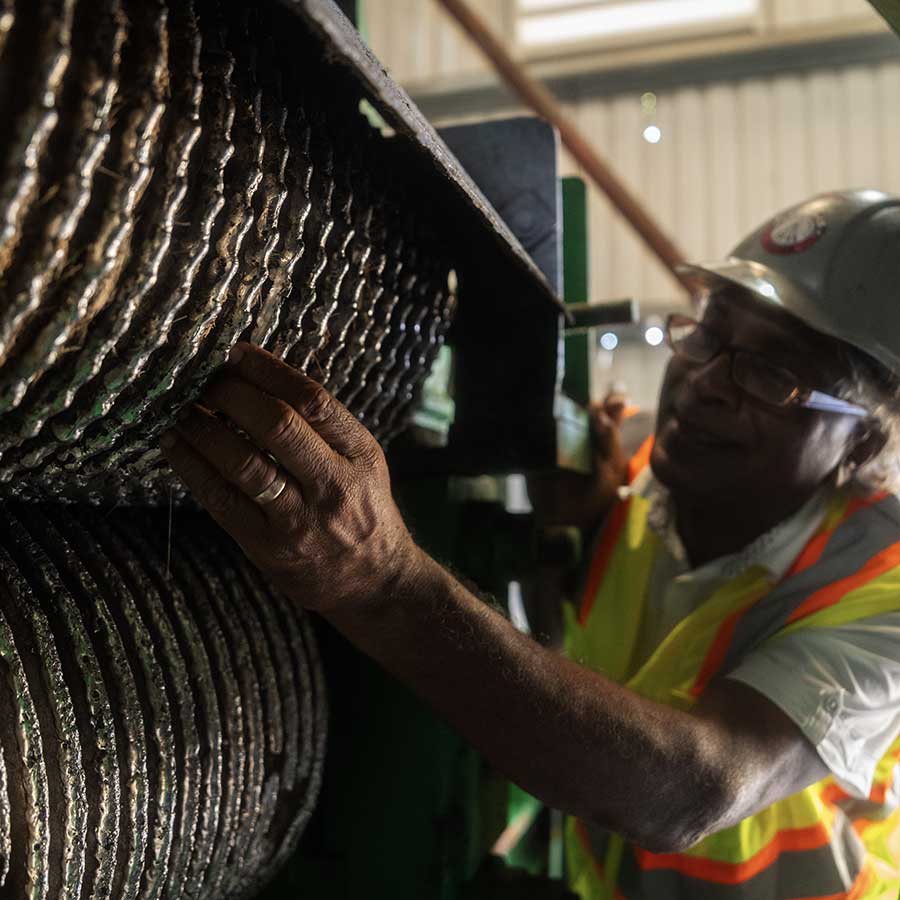
Big Gold, which is a large golden cane. ‘And finally, Lucky Cane, because Barbadians love it; it’s the lucky cane, which they are always chewing,’ says Alexandre Gabriel. ‘And we are currently working on five other varieties.’ The farm also has a 7-tonne cane mill, the Harper Sugar Cane Mill.
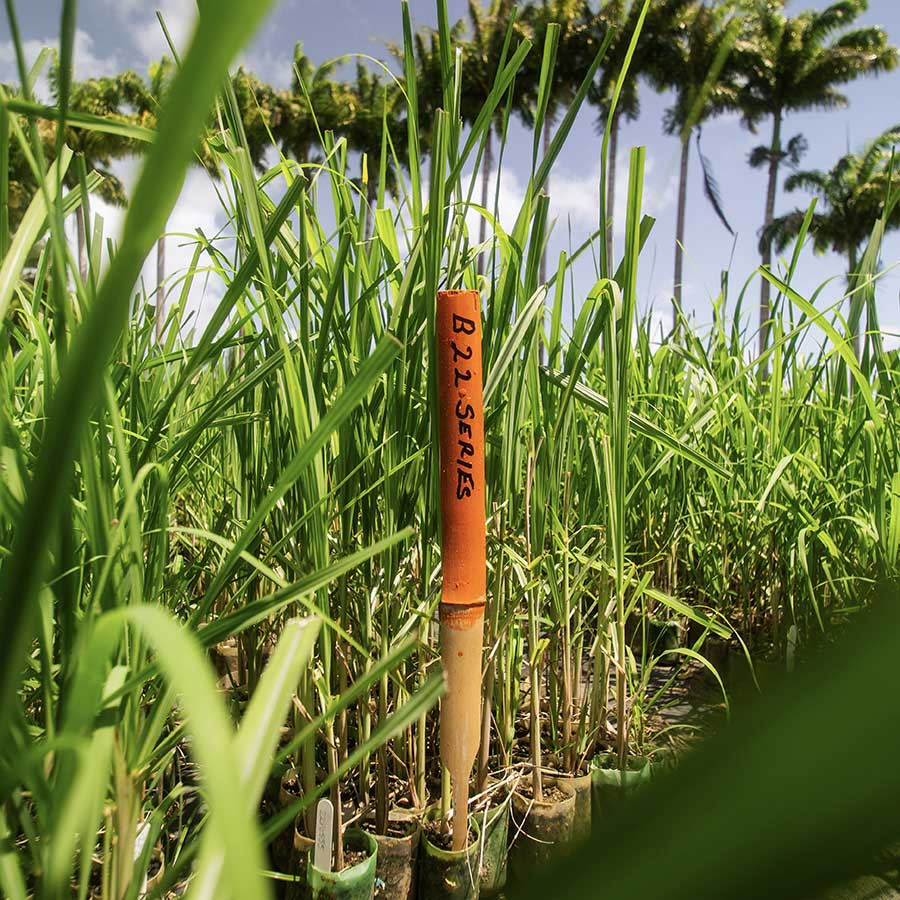
The nursery
Another key part of Stade’s system is the nursery. Here, they work on long fermentation and wild yeasts, all in the open air, with the sea just a few dozen metres away. This came as quite a shock to the young Alexandre Gabriel when he first visited the site at the age of 25.
“Having grown up on a farm and then worked in Cognac, I learned that tools had to be carefully cleaned, bacteria had to be killed, and cellars had to be kept very clean, and then I arrived at a place where bacteria were being cultivated! he recalls. Why? We realised that these bacteria feed on alcohol and acidity to create esters. This was later explained by science. But in Barbados, Jamaica and Guyana, they’ve known this for 150 years.”
As for yeast, ambient and wild strains are preferred. The process takes place in open wooden vats positioned so that they benefit from the sea air.
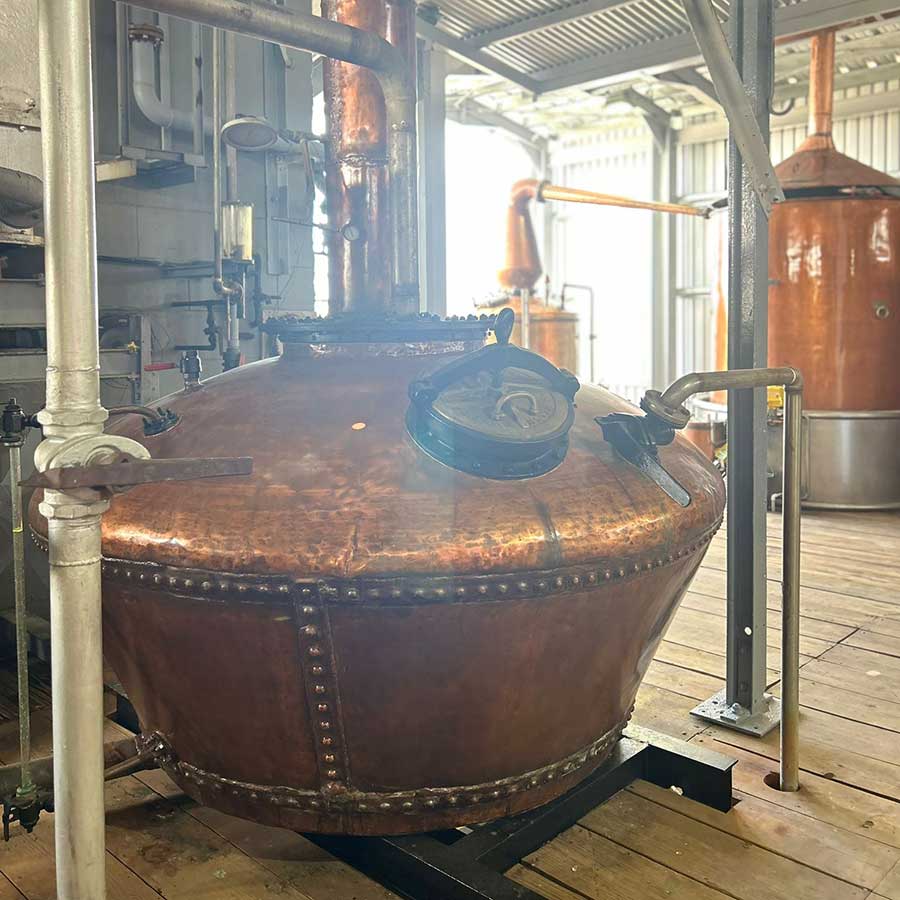
Pot still alley
We therefore understand that Stade’s cuvées will be produced from Barbadian sugar cane, fermented on site with indigenous yeasts (and bacteria). It would be difficult to be more terroir-driven. Except that in spirits, the concept of terroir is broader than in wine.
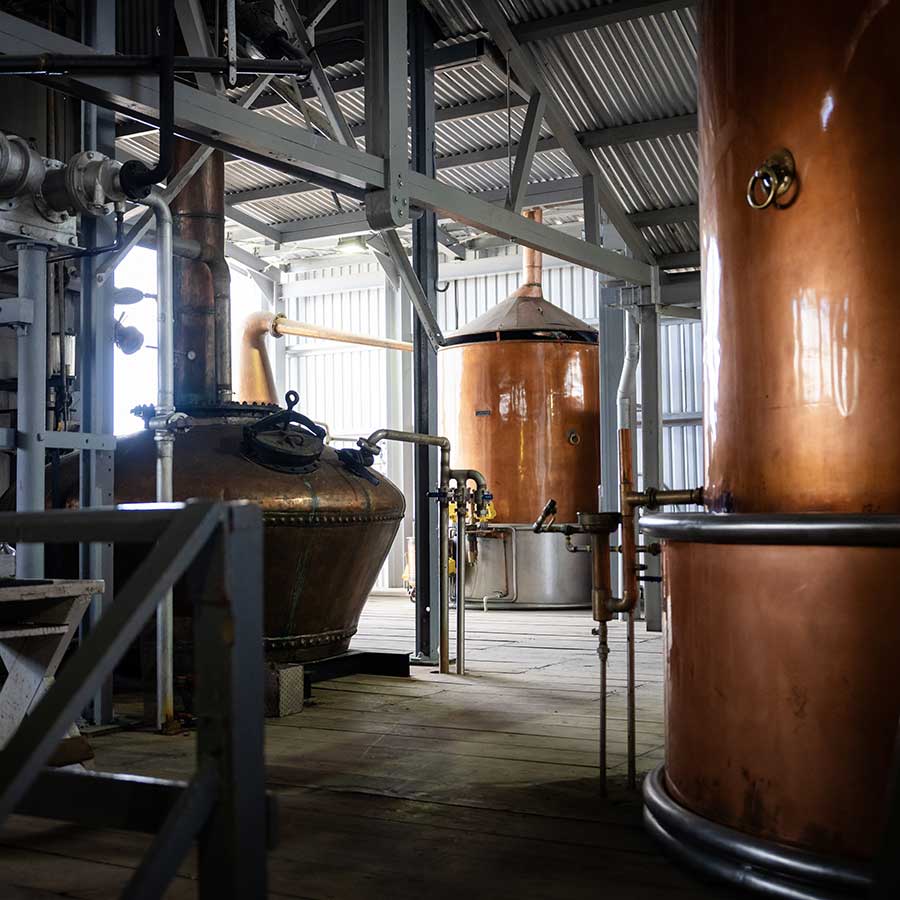
There is also a technical dimension, particularly with regard to the type of distillation equipment used. Stade’s WIRD knows a thing or two about this, as it has nine types of stills and columns, the oldest of which date back to the 18th century and some of which have become legendary: Stade, Batson, Rockley (the oldest copper rum still in the world), Vulcan, Old Gregg, and more. Each one has its own history, personality and importance in the creation of Stade’s WIRD rums, particularly the Planteray brand blends.
But these stills, some of which have been revived thanks to George Stade’s diagrams, while others had been set aside, are now being promoted and have even become the stars of the new brand.
This is even reflected in the brand’s visual identity. The names of the stills that contributed to their creation are printed on the bottle labels. As for the Stade’s Rum bottle, it has a neck shaped like Rockley’s belly with hand-hammered rivets. It is therefore no coincidence that the first two vintages launched by Stade’s Rum give pride of place to two of the distillery’s oldest stills: the Old Gregg and the Vulcan.
Two vintages to start with
The Vulcan Two Taps cuvée was named in honour of the Vulcan triple-chamber still, the last original example still in operation in the world, and still in use at Stade’s.
This extremely rare still was restored in 2018 thanks to Henderson “Digger Skinner, a veteran of Stade’s (45 years with us, and 45 years for his father before him!), who has perpetuated a technique passed down from generation to generation: when the still jams, all you have to do is give it two whacks with a pipe… hence its name.
‘When I realised that this chamber still existed, it had the same effect on me as someone who studies dinosaurs would have if they came face to face with a live T-Rex in their garden,’ recalls Alexandre Gabriel. ‘It’s a prehistoric still that works under pressure, so you have to heat it more, but it produces quite oily rums.’ The rum is aged 100% in Barbados, in ex-bourbon casks.
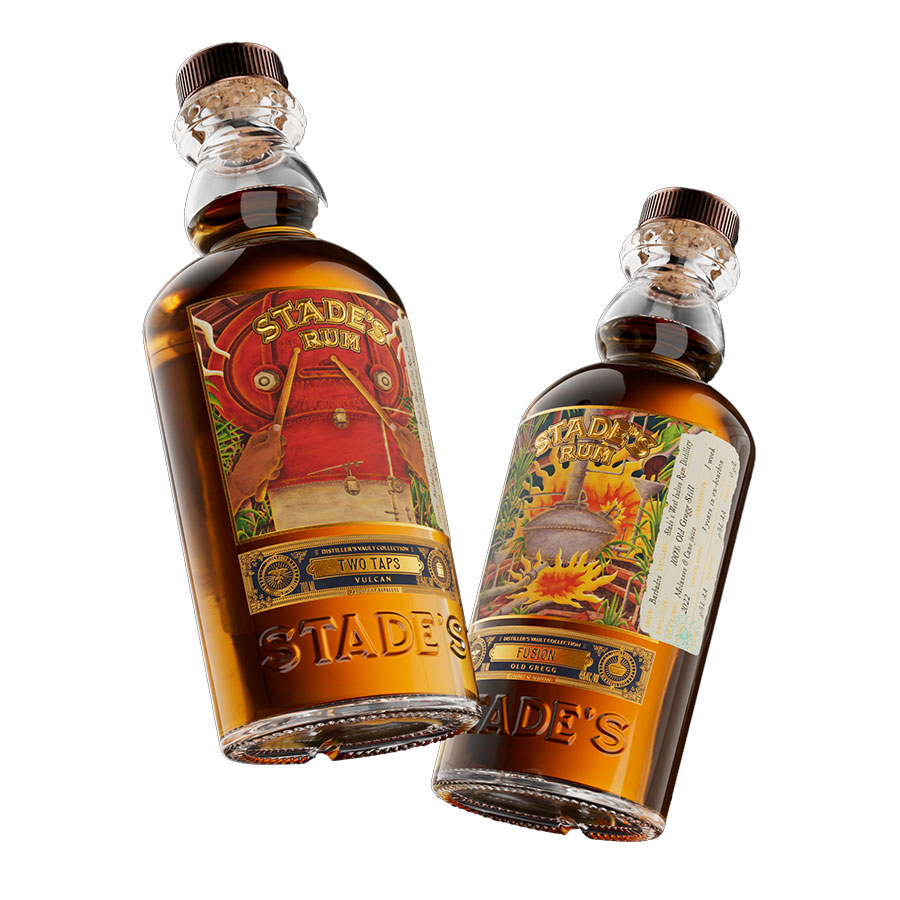
VULCAN TWO TAPS, ÉDITION LIMITÉE, MILLÉSIME 2019
70CL – 50,5% – PVC : 69€
The second edition of the Distillery Vault Collection is Old Gregg, Fusion. It is the meeting point between two Barbadian rum traditions: fresh cane juice – from cane crushed at Stade’s Harper sugar mill – and molasses from Port Vale, the last sugar factory still in operation on the island. all distilled in the Old Gregg pot still, dating from the early 1900s, then aged in Barbados to reveal the vibrant tension between herbaceous freshness and deep richness.
At Stade’s, excellence begins at the source: the distillery works closely with one of the world’s oldest sugar cane variety selection stations to identify and cultivate the best varieties for rum production, true to the belief that all great spirits are born from agriculture. The rum has been aged for three years in Barbados in ex-bourbon casks.
Translated with DeepL.com (free version)
OLD GREGG ÉDITION LIMITÉE MILLÉSIME 2022
70CL – 46% – PVC : 69€
What does the future hold for this new brand? Without a doubt, new experiments straight out of the Vault and the imagination of Alexandre Gabriel and his teams. These will include rums with very high levels of pure cane juice esters, single-estate rums, single-varietal rums… We don’t know yet, but we can’t wait to see (and taste) them!