
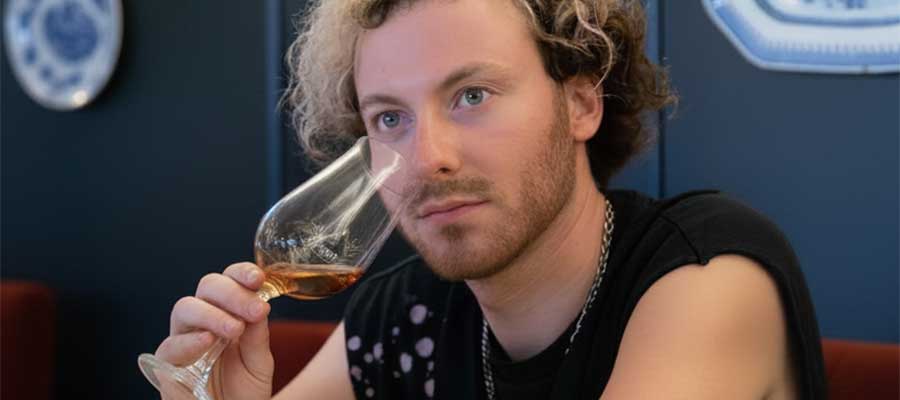
A great lover of rum in general and Mexican rum in particular, Benjamin toured Mexican ron agricola distilleries a few years ago. He shares his experience and knowledge with us.
How did you discover Mexico and its rums?
Initially, I went to Belize to buy rum from Travellers for the Spirit Gallery project, and I passed through Mexico at the invitation of a friend who lived there. Then Covid hit. Instead of returning to France to be confined, I took the opportunity to explore the country and discover its distilleries, mainly those producing rum, mezcal and sotol.
Did Mexicans point you towards rum distilleries?
Of course, but it wasn’t easy. You have to understand that the word ‘ron’ isn’t really associated with a spirit produced in Mexico in the collective imagination, but rather in Cuba or Venezuela. Generally speaking, when someone goes to a bar in Mexico, they’re more likely to order a Bacardí than ask for rum. Over there, Bacardí has a bit of the same clout as Hennessy in the cognac world. The brand dominates the category.
People know Charanda, don’t they?
Charanda has a Denominación de Origen in Mexico—the equivalent of our GI—so you would think it would be a well-known appellation. In reality, however, its fame is mainly limited to the state where it is produced, Michoacán. Unfortunately, it also suffers from a somewhat tarnished image.
It is too often perceived as a popular alcohol of lesser quality. However, there are some excellent Charandas, such as the one produced by Miriam Pacheco under the Sol Tarasco brand, which demonstrates the full potential of this appellation.
How many rum distilleries did you count at the time?
I counted at least seventy across the country. To give you an idea of the density of production, in the valley where Paranubes is located alone, there are more than fifteen microdistilleries.
Do they produce pure cane juice rum/ron agricola or molasses rum?
This is precisely what makes Mexico so fascinating: all four raw materials derived from sugar cane are used there. These include fresh cane juice, molasses, cane syrup and, finally, unrefined raw sugar, known as panela in Latin America and piloncillo in Mexico.
Piloncillo is similar to galabé, rapadura or muscovado: it is pure cane juice that has been heated more intensely and for longer than is needed to obtain syrup, then left to crystallise. The refining process then involves centrifuging it to separate the refined white sugar on one side and the molasses on the other.
What is interesting about piloncillo is that, as it is not an industrial residue like molasses and its production requires more steps than the direct use of pure juice, it is the most expensive raw material of the four. On the other hand, unlike fresh juice, it can be easily stored and transported as it does not start fermenting immediately.
It brings extraordinary aromas of brown sugar and cooked sugar, while retaining a fresher flavour than molasses. Fun fact: in Mexico, the term ‘panela’ is carefully avoided, as it also refers to a very popular cheese from the state of Oaxaca!
Are there any good rum distilleries in Mexico?
Yes, of course. There’s a bit of everything. I think we can divide distilleries into three categories. First, there are the highly industrial distilleries, which distil to a very high proof, and which some might describe as ‘sugar cane vodka’.
In fact, one of Bacardí’s largest production sites is in Mexico. Then there are the traditional craft distilleries – often families who have been producing rum for generations and pass on their secrets, a bit like the maestros mescaleros or French family distillers.
In terms of quality, there is a wide range. As premium rum does not really have a local market, they mainly seek to drive prices down. They do not make large investments (neither in distillation or storage equipment nor in process modernisation – R&D or quality control). The corollary is that quality is often uneven between batches, with some being absolutely incredible and others from the same producer disappointing.
Finally, there is an emerging category: those who want to produce rum in a traditional way while aiming for a certain level of quality and reproducibility. These are often brands targeting the export market, particularly the US, which is more fond of this type of product.
In Oaxaca, Paranubes, Alambique Serrano and Tso’ok are doing a great job. The latter two are distributed in the United States, but not yet in France. In Michoacán, in addition to Sol Tarasco, there is Don Mateo, known for its mezcal, which has launched a very fine rum brand: Danza de Lobos. Many entrepreneurs who have already enjoyed success with tequila or mezcal in the United States are now entering this third segment by creating rum distilleries or modernising existing ones. Capital, particularly from the United States, is therefore flowing into Mexican rum, with an approach designed to appeal to enthusiasts.
Could Mexico become one of the future rum countries?
Absolutely. All the elements of a mature ecosystem are in place: good distillers, remarkable diversity of raw materials, an influx of capital and experienced entrepreneurs who have already proven themselves with mezcal and tequila brands. Mexico also has structural advantages: inexpensive sugar cane that grows all year round, an accessible workforce, and a huge territory.
Another key factor is the growing global demand for pure juice rums, particularly among enthusiasts. Mexico has a long tradition of producing ‘agricola’ rum—our equivalent of pure juice, as the term ‘agricultural’ is not protected in Mexico. Several of the producers I mentioned already offer magnificent bottlings of pure juice distilled in pot stills using single-varietal cane, exactly what our community of enthusiasts loves. There are already some very fine examples, and everything indicates that this trend will grow in the coming years.
Read also: Focus Terroir – Mexico, the new frontier for rum?