
By Javier Herrera, with Fabien Humbert
The history of rum in Mexico is closely linked to the arrival of sugar cane, cultural mixing and the economic development of the viceroyalty. Its development in Mexico represents a unique fusion of indigenous tradition, European technology and the American tropical climate.
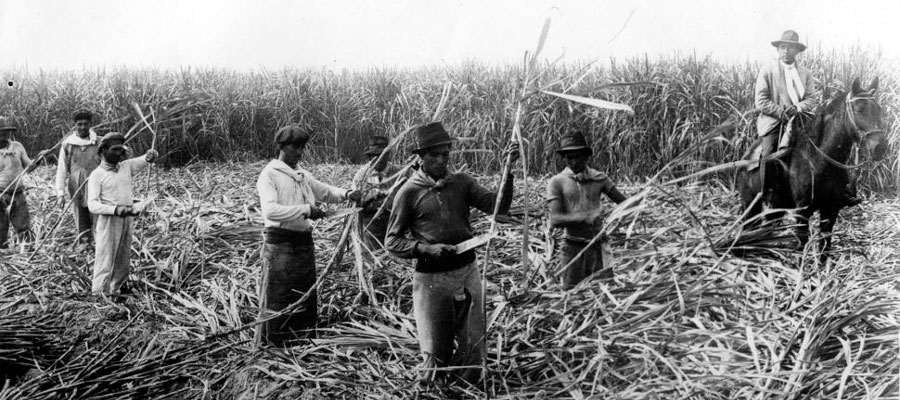
I. Arrival of sugar cane (1520–1600)
Sugar cane was introduced to Mexico by the Spanish around 1520, a few years after the fall of Tenochtitlán, the capital of the Aztec empire. Hernán Cortés, aware of the economic value of sugar in Europe, ordered the first strains brought from Cuba and Saint-Domingue to be planted in the fertile lands of Veracruz and Morelos.
By the mid-16th century, there were already numerous sugar mills (trapiches), mainly small installations powered by animal or hydraulic force, which crushed the cane to obtain syrups and sugar loaves (papelones). These by-products, subjected to spontaneous fermentation, gave rise to cane spirit (aguardiente de caña), a preliminary step in the production of rum (at least in Hispanic countries).
In those early days, distillation was carried out in rudimentary copper or clay stills, a legacy of Arab technology that the Spanish had adopted centuries earlier. The spirit was mainly intended for local consumption and barter, particularly in coastal areas where African slaves and indigenous workers demanded strong, sweet drinks.
The word ron (rum) was already in use at that time. One theory (held by a minority) attributes its origin to the scientific name for sugar cane (Saccharum officinarum). It was not recorded, and as always, the British adopted the word when it was already in use in the French and Spanish colonies.
II. Creole brandy (1600–1750)
During the 17th and 18th centuries, sugar became one of New Spain’s main exports. The valleys of Cuernavaca, Córdoba, Orizaba, Oaxaca and Colima were filled with factories producing both sugar and molasses.
As production increased, molasses began to be used systematically to make local spirits, which were much cheaper than liqueurs imported from Europe. These drinks, popularly known as ‘chiringuitos’, a word that came to Mexico from Cuba from the term chorrito de caña (a small stream of cane), were part of the viceroyalty’s internal trade, despite the Crown’s prohibitions.
For over a century, Spain attempted to curb and persecute local cane distillation, fearing that it would harm the wine and brandy trade. The word ron was banned. But economic reality overtook the law: popular demand and low production costs made Mexican rum a common drink, especially in rural and coastal areas.
In 1714, a decree was drafted and issued by the Kingdom of Spain to protect the production and sale of brandy and wine, which were the metropolis’s favourite spirits. This measure was intended to eliminate the competition that rum posed to products from the Iberian Peninsula.
Despite the ban, rum production continued clandestinely. Ships returning to Spain with empty barrels were filled with rum, often Mexican, for subsequent illicit sale. Rum went on to become hugely popular, as it was more appreciated than brandy. Reports from the time indicate that soldiers preferred rum to brandy for its ‘sweetness and smoothness.’
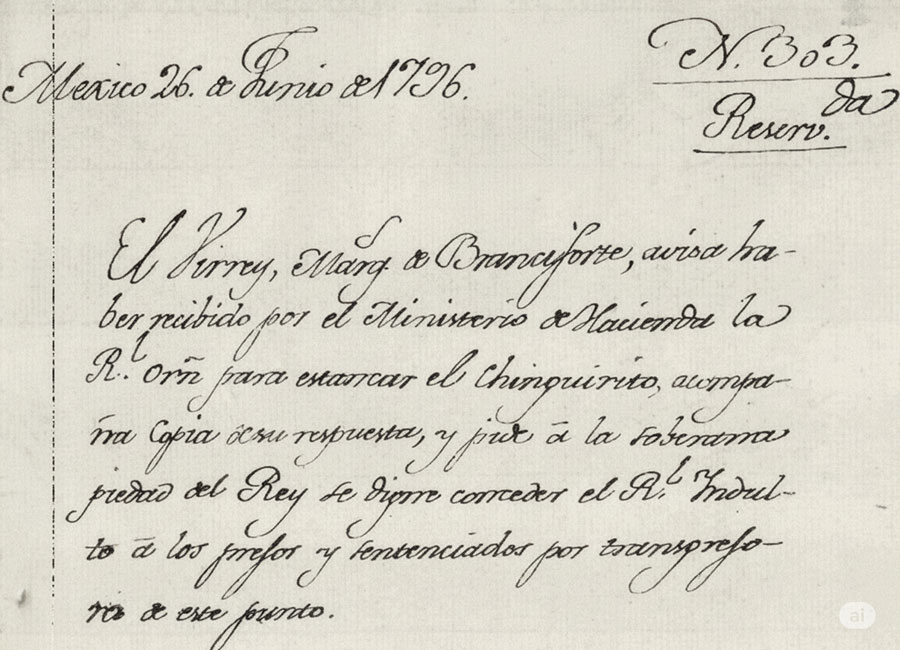
Order of the King of Spain authorising the production of rum in Mexico (1796)
III. From prohibition to legalisation (1750–1821)
By the end of the 18th century, rum or cane spirit was already part of everyday life in Mexico. However, the Spanish Crown intensified controls and monopolies on alcohol, imposing taxes and licences.
Far from eliminating production, these measures encouraged smuggling and the proliferation of small clandestine distilleries. In Veracruz and Yucatán, local spirits competed with rums from the British Caribbean, imported by English and Dutch merchants.
Many of these foreign rums were mixed or cut with Mexican brandy, resulting in hybrid products that circulated without labels or controls. The ban remained in force until 1796, when restrictions were eased and the Spanish Crown recognised the economic potential of rum in its colonies.
By royal order of 19 March 1796, issued in Aranjuez (Spain), the production, sale and consumption of the aforementioned chinguirito (Rum/Chiringuito) were authorised. The 1796 on the Venezuelan brand Santa Teresa refers to this date.
The lifting of the ban allowed rum to be produced and sold openly, and its production and export became an economic driver for many regions. However, this process did not occur in a specific year, but rather over a period of change in colonial policy.
IV. Mexican Independence (1821–1860)
With Mexico’s independence in 1821, cane spirit production was liberalised. The new Mexican state promoted local agriculture and industry, and many factories that had been abandoned during the war resumed operations.
In Veracruz, Colima and Oaxaca, some distilleries began to produce more systematically, adopting modern column distillation technology imported from France and the United States. Although the term ‘rum’ (ron) was not yet in common use in Mexico, the beverages produced at that time were already of better quality. Rum became very popular throughout Mexico.
V. Industrialisation (1860–1900)
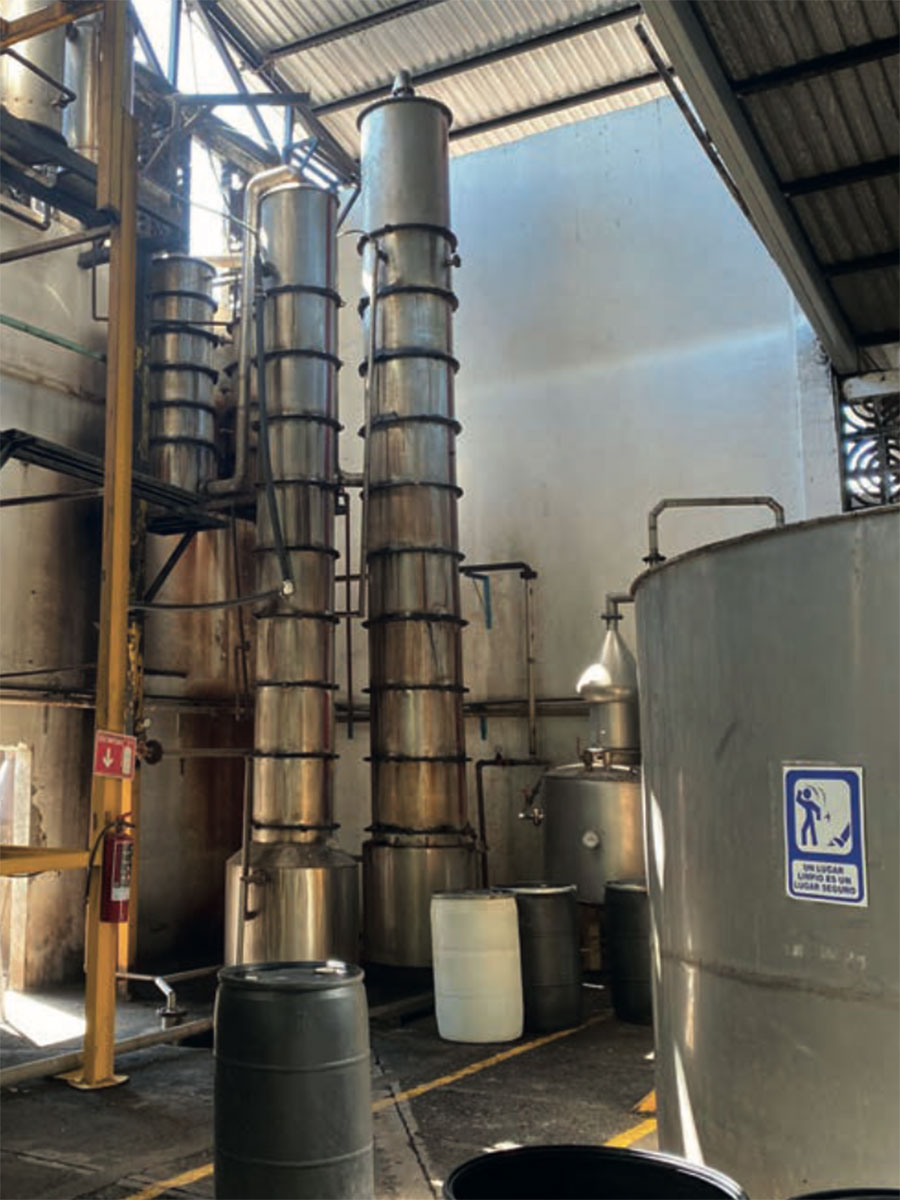
From 1876 to 1911, Mexico underwent rapid industrial modernisation. Steam engines, metal mills and continuous distillation columns were introduced, enabling the production of higher quality spirits. Rum, now bearing its own name and following Cuban and Caribbean models, began to distinguish itself from simple brandy. In Veracruz, Oaxaca, Chiapas and Colima, several Creole and mestizo families founded formal distilleries that marketed ‘Mexican cane rum.’
Although its production did not achieve the renown of Cuba or Jamaica, Mexican rum found its identity in the use of local cane molasses and a drier, lighter style that suited the tastes of the domestic market. Some tax records from the late 19th century already mention modest exports to the United States and Central America.
VI. Revolution and Resurgence (1900–1930)
The Mexican Revolution (1910–1920) interrupted this development. Many factories were destroyed or abandoned; the stills remained silent among the burnt cane fields. However, the tradition of producing spirits survived, maintained by farmers and small distillers who made their own artisanal rum for local consumption.
After the conflict, the new revolutionary government promoted the recovery of the sugar industry as a symbol of national reconstruction. The factories were gradually modernised, and with them distillation reappeared, now with a more technical and regulated approach.
VII. Consolidation (1930–1960)
From the 1930s onwards, Mexican rum began to establish itself as a national product. During this period, large sugar companies installed continuous distillation columns, similar to those used in Cuba and Puerto Rico, enabling them to produce higher purity alcohols under controlled conditions. One of the highlights of this period was the arrival of Bacardí in Mexico.
The Cuban company, seeking to expand and protect itself from the political uncertainties of the Caribbean, built its first distillery outside Cuba in 1931, in Tultitlán (State of Mexico), and later in Veracruz. Its presence marked the beginning of large-scale rum production with international standards.
At the same time, national producers emerged, retaining a regional character, with styles varying according to climate, type of cane and local tradition. In Chiapas, for example, sweeter and smoother rums were produced. In Colima and Oaxaca, drier and more robust versions were produced.
And in Veracruz, balanced rums with tropical notes. During this period, Mexican rum began to form part of the popular identity: at fairs, in cantinas, marimbas and rural celebrations, the bottle of rum became a symbol of joy and brotherhood.
VIII. Modernisation and crisis (1960–1990)
Industrial growth and the development of tourism in the Caribbean partially displaced Mexican rum from the international scene. Cuban, Dominican and Puerto Rican brands consolidated globally, while Mexico focused its alcohol industry on tequila and mezcal, products more closely identified with its national identity.
Despite this, rum never disappeared. Distilleries such as Bacardí México, Ron Mocambo and Ron Castillo maintained constant production. In regions such as Veracruz and Chiapas, factories continued to distil cane alcohol and molasses, both for rum and other liqueurs.
In the 1970s and 1980s, the Mexican government promoted agricultural modernisation policies that affected sugar cane cultivation, integrating peasant cooperatives and encouraging the production of industrial alcohols and fuels, which had indirect effects on rum: distillation increased, but not always in terms of quality.
IX. Renaissance 1991–2025
Today, after a decline in the rum industry, mainly due to the huge success of agave-based drinks, rum in Mexico is experiencing a new phase, revived by entrepreneurs who are betting on rum, even though it goes against the grain. New distilleries are beginning to emerge and old ones are reappearing with products that are very interesting from my professional point of view.
It must be acknowledged that, during this period, there were many poor-quality products, focused solely on price and sales. But for the past decade, we rum producers have turned our attention to this great country for high-quality rums, whether juice- or molasses-based.
Read also: Focus Terroir – Mexico, the new frontier for rum?